
The bee got me on the middle finger of my right hand, and I sat down and cried.
I was six, maybe seven. I can put you exactly where it happened, because I could walk that house blindfolded today.
You came in through the zaguán, the receiving room at the front. Past that the house opened into a wide hallway with no roof over it at all — just sky. The sala on your left, the kitchen on your right, and down the middle a garden, with a walkway running along either side of it.
The floors had been dirt once. I remember them. There were stepping stones set from the sala across to the kitchen so you could get over without sinking. By the time of the bee they’d been paved.
The bee got me near Mama Victoria’s plants. She grew them in buckets — the same buckets we set out under the sky when it rained, because a hallway with no roof takes on water.
I sat down on the concrete and cried the way children cry when they’re waiting. Loudly enough to be heard from the kitchen, with pauses in it for someone to come.
Nobody came.
Then Papa Chuy came out of the zaguán, headed down the left-hand walkway toward the back — toward the two rooms my tío had sent money home to build, where Papa Chuy taught me to read.
He saw me on the ground and he stopped.
¿Qué te pasó? (What happened to you?)
I held up the finger. He crouched down — carefully, because of the hip — and pushed his hat back off his forehead so he could see it properly. He took my hand and turned it toward the light.
He looked at that finger the way a man looks at a real injury on a real person.
Then he kissed it.
Ya no llore, mija.
He patted my shoulder twice, straightened up, and went on down the walkway. The hat stayed pushed back.
Thirty seconds. He did not sit down with me. He did not stay.
Here is what I have never been able to explain to anyone, and what I am going to try to explain now.
I was in shock that he stopped.
That is the truth of it. A grown man in that house, in the middle of going somewhere, saw a child crying and stopped — and I did not expect it, and it undid me. I had not been raised to expect it. When you fall in that town, you get up.
And his voice. Ya no llore, mija. There was such gentleness in it. Such plain, unhurried sweetness, from a man who barely spoke, who had somewhere to be, who was already halfway down the walkway in his mind.
I sobbed for a few seconds longer after he said it. I couldn’t stop right away.
And then something in my chest turned over, and I started to smile instead.
I got up. I walked away. And I went about the rest of that afternoon carrying a thing I hadn’t had that morning, which was the knowledge that somebody cared. Not in theory. Not because they were supposed to. Somebody had crouched down in a garden and looked at my finger.
I want to be honest about what that did and what it didn’t do.
It filled me. For a good while, it filled me completely, and I did not go around wondering whether I was wanted.
But the question came back. A child who has been left doesn’t get to settle that once and be finished with it. It returned at odd hours for years, in new clothes, asking the same thing. Why did he go. What was wrong with me. A wound like that doesn’t close because someone was kind to you in a garden.
What that moment did was hold me. It was enough to be going on with, and then enough again, and then enough again, for as long as I needed it to be.
I don’t ask that question anymore. It stopped, eventually — not because I got over it, but because I got somewhere. I know who I am now. I know what I carry and where the scars are, and I’ve stopped negotiating with any of it. My story is mine. It does not define me; it made me strong, which is a different thing entirely.
I know where I belong. I stand up straight, shoulders back, without one ounce of shame.
But I would not be that woman without a man who crouched down in a garden for thirty seconds when he had somewhere else to be.
I am still drawing on it.
I don’t remember many hugs.
I want to say that plainly, because of everything that follows, and because I’ve noticed that when people describe a beloved grandparent they reach for arms and laps and being held. I can’t give you that.
I should say something about the names, too, since I’ll be using them.
We never called them abuela and abuelo. They didn’t like it and they didn’t answer to it. They were Mama Victoria and Papa Chuy — to us, and often to other people as well, as a mark of respect. I understood that as children understand things, which is to say not at all, and only much later worked out that it was simply accurate. They weren’t grandparents doing us a kindness. They were raising us. Las quiero como si fueran mis hijas, they used to say — I love you both as if you were my daughters — and a woman who says that does not answer to abuela.
So: Mama and Papa. That’s what they were.
And they were busy people. There was always something being tended — animals, laundry by hand in the sun, a fire lit under the shower boiler thirty minutes before anybody could wash. Nobody in that house sat down to hold a child.
I have almost no memory of being held there.
I have never once, in my whole life, wondered whether I was loved there.
It took me until adulthood to work out how they managed that.
Papa Chuy was the mailman of our town. He sat at a small table near the entryway of the house, and people came to him to collect their letters. In his younger years he carried the mail out on horseback. Later, after a fall from a horse left him with a limp he kept for the rest of his life, he went by bicycle.
The bicycle was yellow, scratched and worn down by years of it, and it had a parrilla on the back — a heavy metal rack, thick bars, built for carrying things.
Sometimes he let us come with him.
My sister and I would climb onto that rack and hold on tight, and he’d pedal us through town, house to house, delivering the mail with two little girls on the back.
I want you to understand that he did not need us there. A man with a bad hip does not require children on his bicycle. He brought us because he wanted us with him, and I think now that an afternoon of holding onto a man’s waist while he worked was as close as he could get to saying so.
We tried to ride it once by ourselves. We fell. We did not attempt that again.
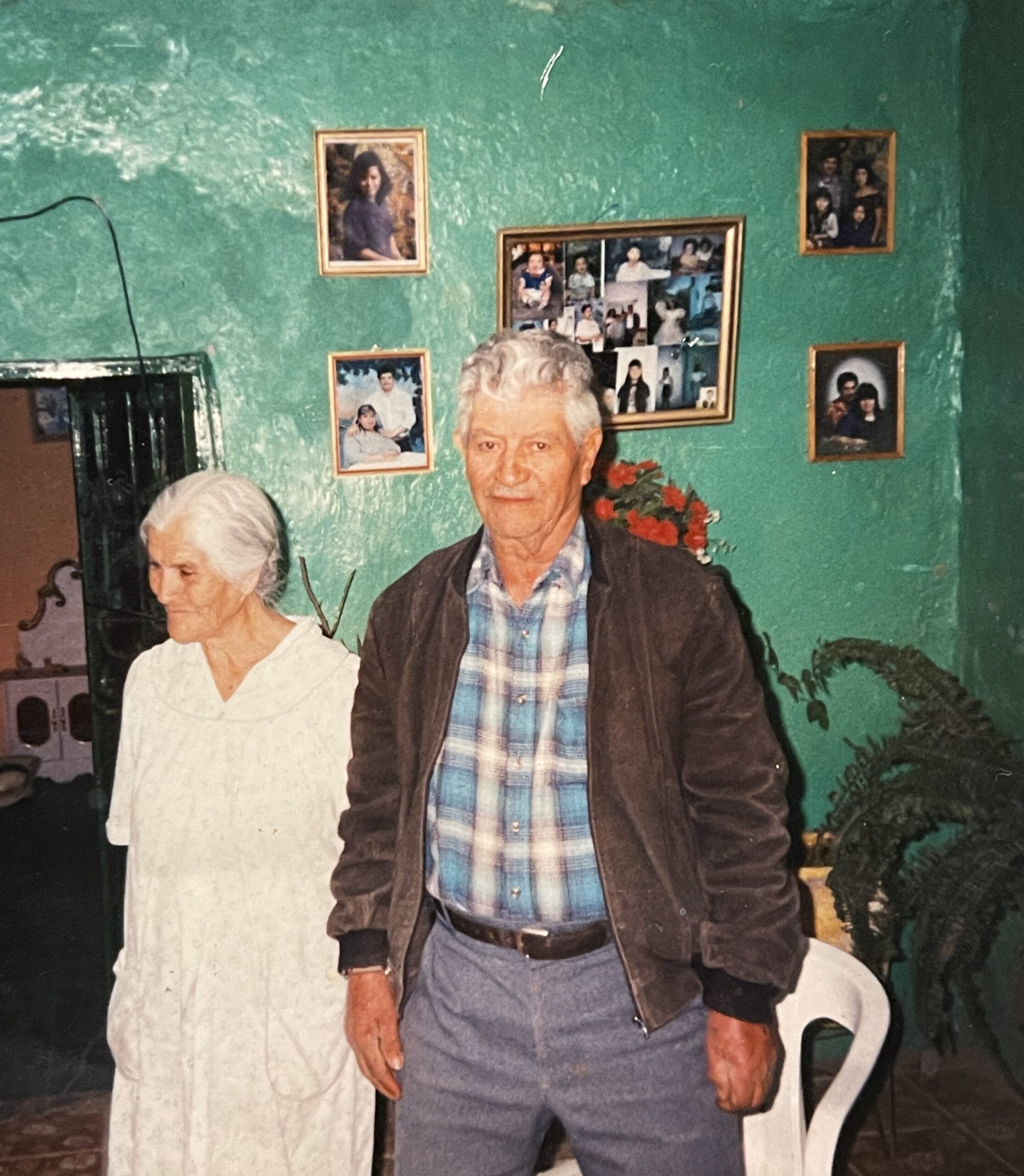
He was not a man of many words. He carried himself with dignity — clean clothes every day, hair fixed, cologne on before the morning had properly started. Mama Victoria ironed his shirts, and when she couldn’t, he ironed them himself. Even in his seventies he looked strong to me. He walked with a limp and he walked like a man who had somewhere to be.
There’s one more thing about that house I want to put down, because I’ve only recently understood what it was.
My tío — Papa Chuy’s son — sent money home from away to have two rooms added on. Rooms for himself, for whenever he came back.
He didn’t live in them. He came and went. But Papa Chuy’s position on the matter never moved: if his son ever needed a place to stay, he had his two rooms.
They kept them. Built and waiting, for a man who had gone.
And those were the rooms where he sat me down at a wobbly little table and taught me to read.
The room built for a son who left is the room where he taught a granddaughter who had been left. Nobody in that house would have said it out loud, or noticed it, or thought it worth remarking on.
He had a horse that would not let anyone else near him. Only Papa Chuy. I can still hear the sound he made when he called that animal — I couldn’t write it down for you, but I could do it out loud.
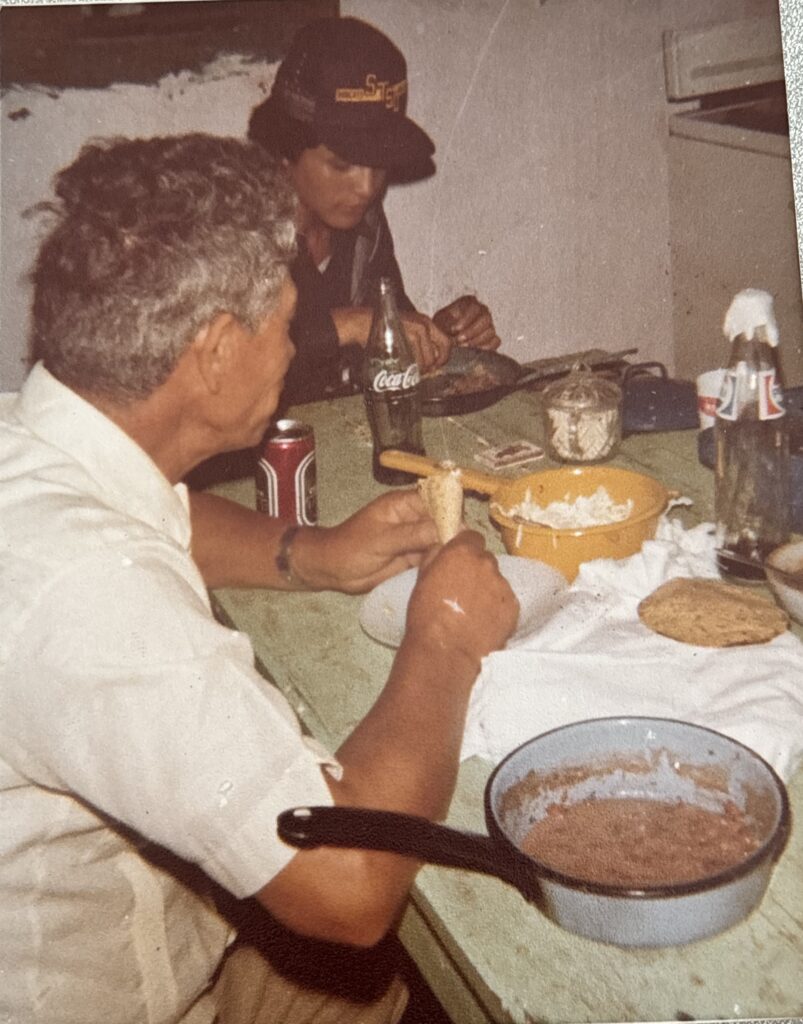
Three eggs, sunny side up, every morning. He loved meat and almost never had it; we were poor and meat came maybe once a month.
And in the evening, after dinner, I went and found him and asked for fifty centavos.
He gave them to me. Every evening.
He’d reach into his pocket, put the coins in my palm, and close my fingers over them. Fifty Mexican cents — exactly one small candy from the store down the block, the one we all called Concha’s after the woman who ran it.
Then I walked down the block, bought my one candy, and walked back.
That was it. That was the whole thing.
There was no speech attached to it. He didn’t ruffle my hair or tell me he loved me. He reached into his pocket and put the coins in my hand, and I went, and I came back, and the next evening we did it again.
I did not know at the time that I was being loved. I thought I was getting candy.
The woman at the store used to embarrass me about it. In front of whoever was standing there, she’d make a remark about the girl who never had money for more than one piece.
She was right that I only ever had fifty centavos. What she didn’t understand — what I couldn’t have explained to her at that age, and wouldn’t have bothered trying — is that I wasn’t disappointed. One candy was the whole point. One candy was what the evening was for.
I have thought about that woman a few times over the years, and I find I don’t hold it against her. She saw a child with very little money. She was right about the money. She was wrong about everything else.
Sometimes he went to the city, an hour away on the bus. He’d come back with payaso pops — chocolate-covered marshmallow on a stick, with a clown printed on the wrapper — for my sister and me.
An hour there. An hour back. A grown man with a bad hip on a bus, thinking about two little girls at home.
That’s what I mean about the hugs. He wasn’t going to sit me on his knee and tell me what I meant to him. He was going to be somewhere else, and think of me, and bring back something small.
He used to sit outside our door on the banqueta — a raised sidewalk, high enough for a man to sit on comfortably — and eat an apple. He always peeled it first, with the pocket knife he carried.
If I sat down next to him, sometimes he’d hand me a slice. Then I’d run off and play again, and he’d finish his apple.
That was the whole visit. A slice of apple and a few minutes on a raised sidewalk.
And then there is the one that still makes me laugh out loud, by myself, all these years later.
I always sat to his left at the table. That was my spot; nobody assigned it and nobody ever took it.
I didn’t like meat. Mama Victoria made caldo de pollo, and there would be a piece of chicken leg in my bowl, and meat in that house was not a thing you left in a bowl. So I’d wait until she wasn’t looking and slide it into his.
Sometimes he’d catch me and just take it. Sometimes he’d signal for it — a small motion, no words, give it here. And sometimes he’d look straight ahead and then cut his eyes over at me, side-eye, saying absolutely nothing.
We never once discussed it. Not one time, in years. It was a conspiracy of two, conducted entirely in glances, over soup.
I don’t think I understood then that being in on something with a person is its own form of being loved. I understand it now.
I’ve come to believe there are two kinds of love and we’re only taught to recognize one.
There’s the kind that says so out loud. Warm, obvious, impossible to miss. That’s the one we’ve all been taught to look for — the kind in the movies and on the greeting cards. And when we don’t get it, we decide we weren’t loved.
And then there’s the other kind. Small, wordless, and repeated without fail for years. Fifty centavos after dinner, every single evening, for as long as I lived in that house. A man who never once forgot, never once said he was tired of it, never once made me feel like I was asking for something.
As a child I could not have told you that this was love. But I never doubted I belonged in that house, and I think I know why now. He did that one small thing so many hundreds of times that it added up to something a child could stand on.
I keep this in mind now that I’m the one running a house.
Because I am the demonstrative, say-it-out-loud kind. My children get told, out loud, more times a day than is probably necessary. That’s my way and I don’t intend to change it.
But I’ve stopped assuming it’s the only way, or that the people around me who don’t do it aren’t doing anything. Some people love in speeches. Some people love in fifty centavos, every evening, for years, without ever mentioning it.
The second kind is easy to miss. It’s also, I have come to think, the harder one to sustain — because a speech takes a minute and a repetition takes a lifetime.
He has been gone a long time now. My how I miss him.
What I have of him isn’t a conversation. We were never that.
What I have is the weight of two coins in a closed fist, and the walk down the block in the evening, and the plain childhood certainty that if I went and asked, he would give.
That is not nothing.
That is, I have come to believe, very close to everything.
Con cariño, Abril



Leave a Reply