Five Desks
The first one
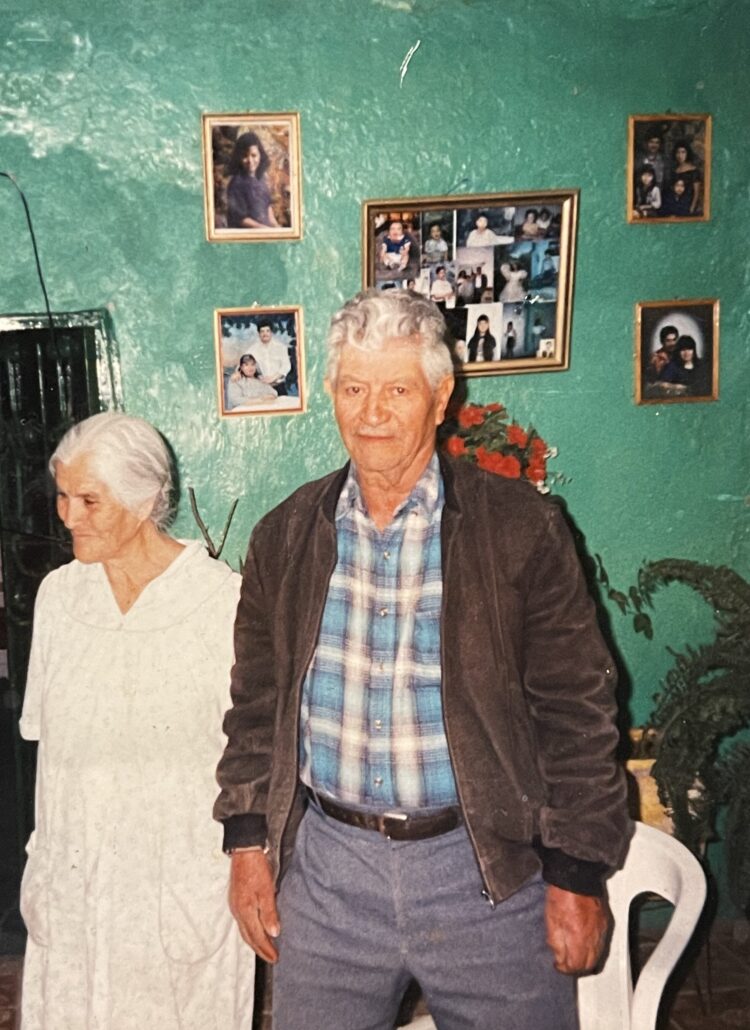
It was in a bright room at the back of the house in Mexico, and it wobbled.
A small wooden thing, leaning against my grandfather’s bed — the one he napped on in the afternoons. In the mornings the sun came through and lit the wall behind it, and that’s where I sat.
I was two and a half when he started teaching me to read there. By four I could read, write, and do basic arithmetic.
He’d lie on that bed with his eyes closed while I struggled through stories from an old history book. Sometimes, without opening them, he’d ask me what nine plus two was, or to recite a multiplication table without looking. Other days he’d sit up on the edge of the bed and watch me write, and gently correct me when I got it wrong.
He was the town mailman. He carried other people’s words from one house to another for a living.
And in a room at the back of an adobe house with a leaky roof, he taught a small girl to make her own.
The years with no desk
I came to America at eleven.
There were five of us eventually — three little ones came after, the youngest when I was fourteen. Three bedrooms, two bathrooms, one income.
My sister and I shared a room. I never had my own. We shared a closet that was too small for two people’s clothes, and there were barely enough dresser drawers between us.
There was no desk.
Not in middle school. Not in high school. Not once, in nine years.
I did my homework at the kitchen table, or on a countertop, or on whatever surface was free at the hour I needed it. Later I studied at the library — not because it was quieter, though it was, but because it was the only place in my life where nobody needed anything from me for a couple of hours.
There was no lock on our bedroom door either. We asked once. My dad said, this is my house, you don’t need privacy.
I understand the sentence now. He was a man holding a household together on one income with five children, and privacy is a luxury of space, and we didn’t have space.
But I want to name the thing plainly, because this essay is about writing and writing requires a surface.
For nine years, I did not have a place to put myself.
The third one
I bought it from Target after I graduated high school. With my own money, which I had saved. It cost a hundred and eighty dollars.
I was working close to full time and bringing home about five hundred dollars every two weeks. So: more than a third of a paycheck. For a desk.
And I the part that I find almost funny now. I bought the wood one.
There were cheaper ones. Particle board, laminate, the kind that bows in the middle after a year. I looked at them and I bought the wood.
Eighteen years old, no money, and already unwilling to buy something that wouldn’t last. I didn’t have a word for that then. I have one now — it’s the same instinct that makes me refinish furniture instead of replacing it, and buy clothes I’ll still have in ten years, and it came from a house where nothing was ever thrown away because nothing could be.
I loved that desk more than almost anything I’ve ever owned. It was the first place in my life that was for me. Not shared, not borrowed, not a kitchen table I had to clear before dinner. A surface with my things on it that stayed where I put them. Eighteen years old. That’s a long time to wait for a desk.
I didn’t think of it as remarkable at the time. It was a thing I needed and nobody was going to buy it, so I bought it.
That’s how I’ve done most things since.
The fourth one
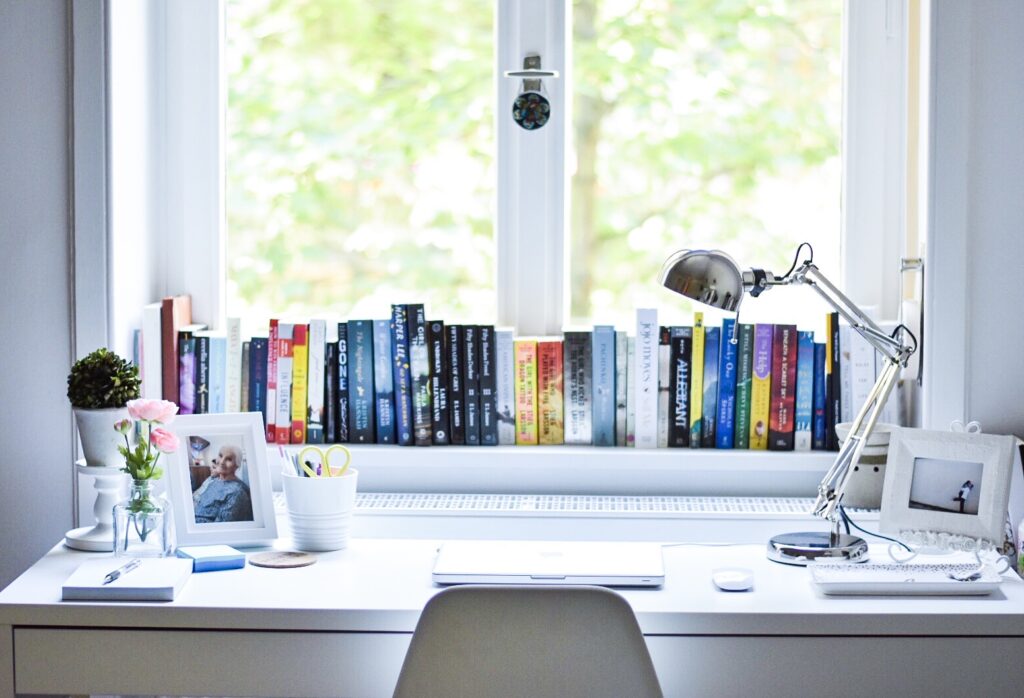
White. From IKEA. It was in Germany.
We lived there three years, in a renovated apartment from the 1890s — tall windows, original wood doors, plaster molding around ceilings I couldn’t have reached on a ladder.
I put the desk in the bedroom, second floor, facing the street. The window sat level with the branches. It felt like writing in the trees. In the mornings I could hear the birds before anything else in that apartment was awake, and five minutes down the road a church built in 1892 would ring its bells, and I would think — without understanding why yet — of a church three blocks from an adobe house in Mexico.
I lined the whole windowsill with books. More books than desk. And on the left, where I’d see her every time I looked up, a photograph of my Mama Victoria.
Of all my adult desks, that one is my favorite and it isn’t close. I thought a great deal there. I grew up a good bit there too — in the way you do in your thirties, quietly, without announcing it to anyone. A lot of what I understand about my own life, I understood first while sitting at that window.
It was a cheap white desk from IKEA, seven thousand miles from everyone I came from.
I still have it.
The fifth one
My study has olive walls and built-in shelves and a desk by the window.
The window looks onto the front porch, so the light that comes in is soft and diffused — the good kind, the kind that doesn’t glare.
I’m writing this at it.
It’s in a house I built. Not bought — built. I acted as my own subcontractor, made the calls, walked the site, argued about the framing. A girl from an adobe house with a leaky roof and a bucket ritual, project-managing a build on acreage in Texas.
But here’s the part I actually want to say
I don’t write at that desk all of the time.
I write on the kitchen counter, standing up, while something is in the oven. I write at the kitchen table with children moving around me. I write on my phone at eleven at night when a sentence arrives and won’t wait.
Five desks, and it turns out the desk was never the point.
Because for nine years I believed the reason I couldn’t do more was that I didn’t have a place. And then I got the place — a good one, exactly the one I would have designed — and I found out that what I actually do is write wherever I happen to be standing.
Which is also why the white desk still matters, and why I brought it home from Germany instead of leaving it behind. It sits in our schoolroom now. By a window, in good light, in a house I built. That’s where I plan my children’s lessons.
A cheap white desk from IKEA, carried across an ocean, in a room where a woman decides what her children will learn. I sat at that desk in a country where I couldn’t speak the language, with my grandmother’s photograph on my left, and I did not know then what it would be for.
The thing I thought was missing was never the surface.
It was permission.
What I know now
That man in the bright room could not have given me a study. He had a leaky roof and a wobbly table leaning against his own bed. He gave me the thing that actually transfers.
He taught me to read at two and a half. He sat with a child every morning for years — a man who barely spoke, who had a mail route to ride and a bad hip, who could have done a hundred other things with those hours.
He put the words in my hands.
Everything since has just been finding somewhere to set them down.
Con cariño, Abril