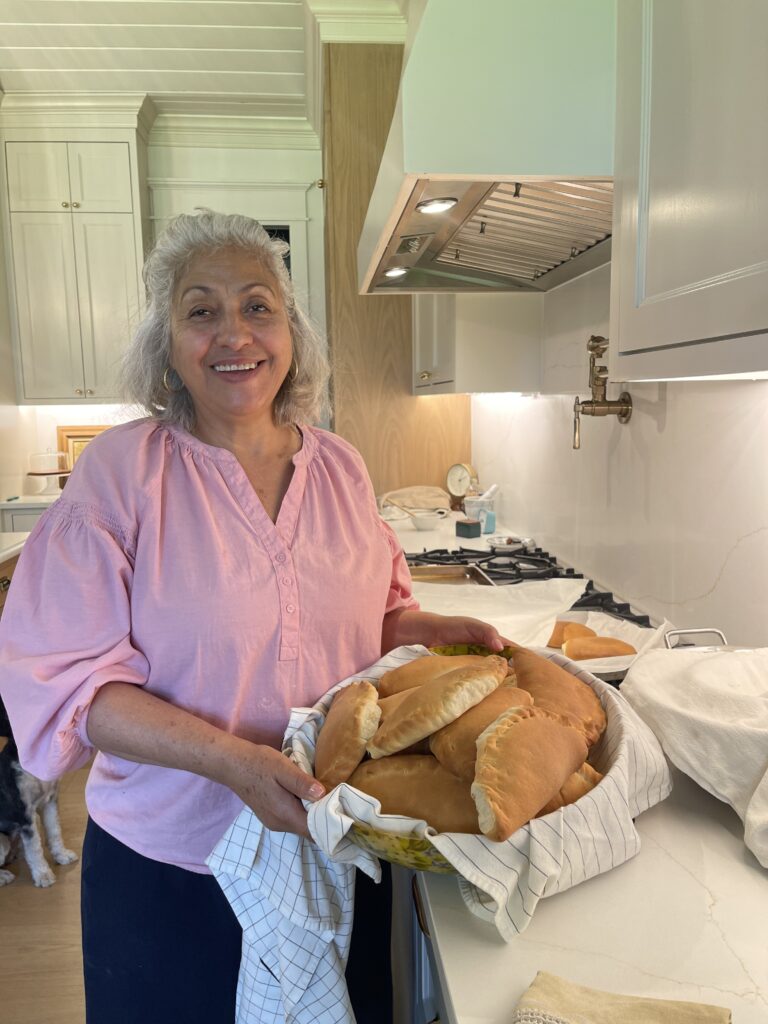
A couple of months back my mother came over and we made empanadas in my kitchen, and I made her stop.
It was her recipe, the one she’s made my whole life, and she was doing what she does, which is cook with her hands. A scoop. A handful. A little of that. And I had a measuring cup.
Wait. How much was that? Do it again, over the cup.
It took twice as long as it should have. She thought it was funny. Every few minutes I’d stop her hand in midair like a woman confiscating something. But I got it down. On paper, in cups and teaspoons, in my handwriting. Her recipe exists now.
My grandmother cooked without measuring. She raised twelve living children in a house with a leaky roof and no running water, and she made everything from nothing — nixtamal started at six in the morning, beans, tortillas, whatever the fields had given that week. There was never a recipe. There was never a card, or a book, or a page in a drawer. She could not read or write.
It was all in her hands.
She made Easter lunch from scratch every single year.
Not lunch exactly — early afternoon, somewhere between noon and two, because there was no exact time for anything in that house and nobody found that strange. It was just the way it was.
Shrimp cakes in a red chili sauce. If I close my eyes I can still taste that sauce. Cactus in red sauce on the side, which makes my mouth water to type. Chuales — dried corn soup — and I can taste that too, thirty years later.
And capirotada, which she let my sister and me help with. Bread soaked in a kind of sweet milk, with raisins and coconut and colored sprinkles on top. There were other things in it. I don’t know what they were. I remember putting the bread in and I remember tasting it. It was my favorite thing she made for Easter.
She cooked all of it on a tiny stove you had to light with a match to get the spark going. If the match couldn’t reach the pilot, we had to light a piece of newspaper to reach it. Looking back, it was a genuine hazard. She didn’t have shelves in that kitchen until my grandfather built her two out of concrete, and I remember trying to help him mix it — and sometimes he’d let me, which tells you everything about the patience of that man.
No measurements. Not once, in any of it. And every single year, that food tasted exactly the same. She served everybody. My uncles would come, and the table would fill, and she would move around it putting food in front of people.
I don’t remember her sitting down. Not once. Not one Easter. She fed a house full of her own children and their children and whoever else had come, and I have no memory of her eating any of it herself.
My mother cooks without measuring. She still chases her mother’s refried beans. Thirty years later, in a different country, with better equipment — and she’ll tell you it isn’t quite right yet.
I know exactly what she’s chasing, because I’ve eaten it. I used to drag a chair over to the stove so I could watch my grandmother stir that pot. That smell is the thing I’m still cooking toward myself, and I’ll never get there either.
My mother’s gorditas taste like my grandmother’s. Mine taste like my mother’s.
And every one of us is working from memory.
I cook without measuring too.
I didn’t decide to. Nobody taught me a method. It’s simply how food happens in my hands, and I couldn’t give you a recipe for my own guacamole if you asked — though I could tell you the rules. Cube the avocado. Never mash it. The cilantro stems go in, not just the leaves. Those aren’t measurements. That’s just what’s true.
Here’s what I’ve been thinking about.
The most important knowledge in most families has never been written down.
Recipes are the visible part of it. The part you notice when somebody dies and the food stops being right.
But it’s everything else too. How a house was run. Why a thing was done that way and not the other. My grandmother used to say, Donde come uno, comen dos. Where one eats, so can two. Somebody would come to the door hungry and she would set another place. I thought it was about food. It was about who gets to stay. I don’t think anyone taught her that. She starved as a child and begged for food.
All of it lives in a person. And then the person goes, and it goes with them, and what’s left is a family saying she made it different somehow for the next forty years.
I sat in my dad’s kitchen last year with a notebook while he made Thanksgiving dinner.
He’s known for that meal. He makes the whole thing from scratch, cooks far more than his household can eat, and sends the extra out to whoever needs it. He got the habit from his own father, an army chef who cooked Thanksgiving dinner in a borrowed room and sent plates down the hall to the neighbors.
He doesn’t measure either. You ask him how much and he says some. You ask him how long and he says until it looks right. So I made him stop too.
I am the one in this family who writes things down. I don’t think that’s a coincidence. My grandmother couldn’t read. My grandfather was the town mailman — he carried other people’s words from house to house on a bicycle — and he taught me to read at two and a half.
An illiterate woman, a man who delivered letters, and a granddaughter with a notebook.
Somebody in every family ends up being the one who records it. If you’re reading this and wondering who it is in yours, it’s probably you.
So here is the thing I actually want to say, and then I’ll leave you alone.
Go ask her.
Whoever it is in your family — the one who cooks by feel, who says a handful and until it looks right, whose food nobody has ever been able to reproduce. Go sit in her kitchen with a measuring cup and be annoying about it. Ask her how much. Then ask her again. Make her do it over the cup. And while you’re there, ask her the other question, the one that matters more: where did this come from before it was yours?
That’s the part that disappears first. Not the ingredients — the lineage. Who taught her. What house it was made in. What they used when they couldn’t afford the real thing.
I made a page for it.
One page. Room for the dish, whose recipe it is, and where it came from before her. Two columns for the ingredients — as she says it on the left, as measured on the right — because you’ll want both, and because her words are half the recipe.
And a space at the bottom for the part that isn’t in any recipe. How she knows it’s ready. What she does with her hands. What she always says while she’s doing it.
It’s blank, it’s free, and it’s here.
Print it. Take it to her. Don’t wait until you have a free Saturday, because you won’t.
My Mama Victoria has been gone since 2022. Nobody ever wrote down how she made those beans.
I’d give a great deal for one page in somebody’s handwriting.
But I want to tell you the last thing, because it’s the reason I’m actually writing this.
That afternoon in my kitchen was not a project. It was full of love. I mean that plainly — it felt good, all the way down, in a place that doesn’t usually get reached. We joked. I teased her. I hugged her about nine more times than necessary and kissed her face while she was trying to work, and I kept saying gracias, mamá, gracias por cocinar su receta — thank you for cooking your recipe for me.
My mother and I have not always had this. We had years apart when I was small. There is a whole long story underneath us that I’m not going to tell here. And we stood in a kitchen and made empanadas and I got to thank her out loud, over and over, in Spanish, while she laughed at me. Something healed that day. I felt it happen.
So when I tell you to go ask her — I’m not only telling you to save the recipe. The recipe is the excuse.
Go stand next to her and be annoying about the measurements. You’ll come away with a page. A real one, in cups and teaspoons, that nobody in your family has ever had.
And you’ll come away with the afternoon — her hands in the flour, her laughing at you, the two of you standing at the same counter for an hour and a half with nothing else happening.
The page is the thing you’ll keep.
The afternoon is the thing you’ll want back.
Con cariño,
Abril
If you want more than the one page, I wrote a guide to asking and recording, called It Lived in Her Hands. It’s $34.


Leave a Reply