
Description
Winter is the only season that asks you to stay.
Spring asks you to start things. Summer asks you to go outside. Autumn asks you to put away.
Winter asks you to stay in one place with the same people for three months, in the dark, and make something of it.
Nobody teaches you how to do that. So most of us just endure it, and then in March we can’t remember a single thing that happened.
Why I wrote it
I got tired of the version of winter I kept being sold. It is always Scandinavian. Wool socks and a candle and a word nobody in my family has ever said. There is nothing wrong with it. It just isn’t my house, and it isn’t my grandmother’s, and it never once told me what to cook on a Tuesday in January.
My winter has a pot of beans on the stove more often than not. It has a day in December when the kitchen fills with people and we make tamales until somebody’s back hurts. It has the sixth of January, and the small piece of bread that decides who owes tamales in February — which is the best-built tradition I know, and almost nobody outside the culture has heard of it.
That’s the winter in this guide. Older than a holiday calendar, cheaper than any of it, and built for a house with people in it.
What’s inside
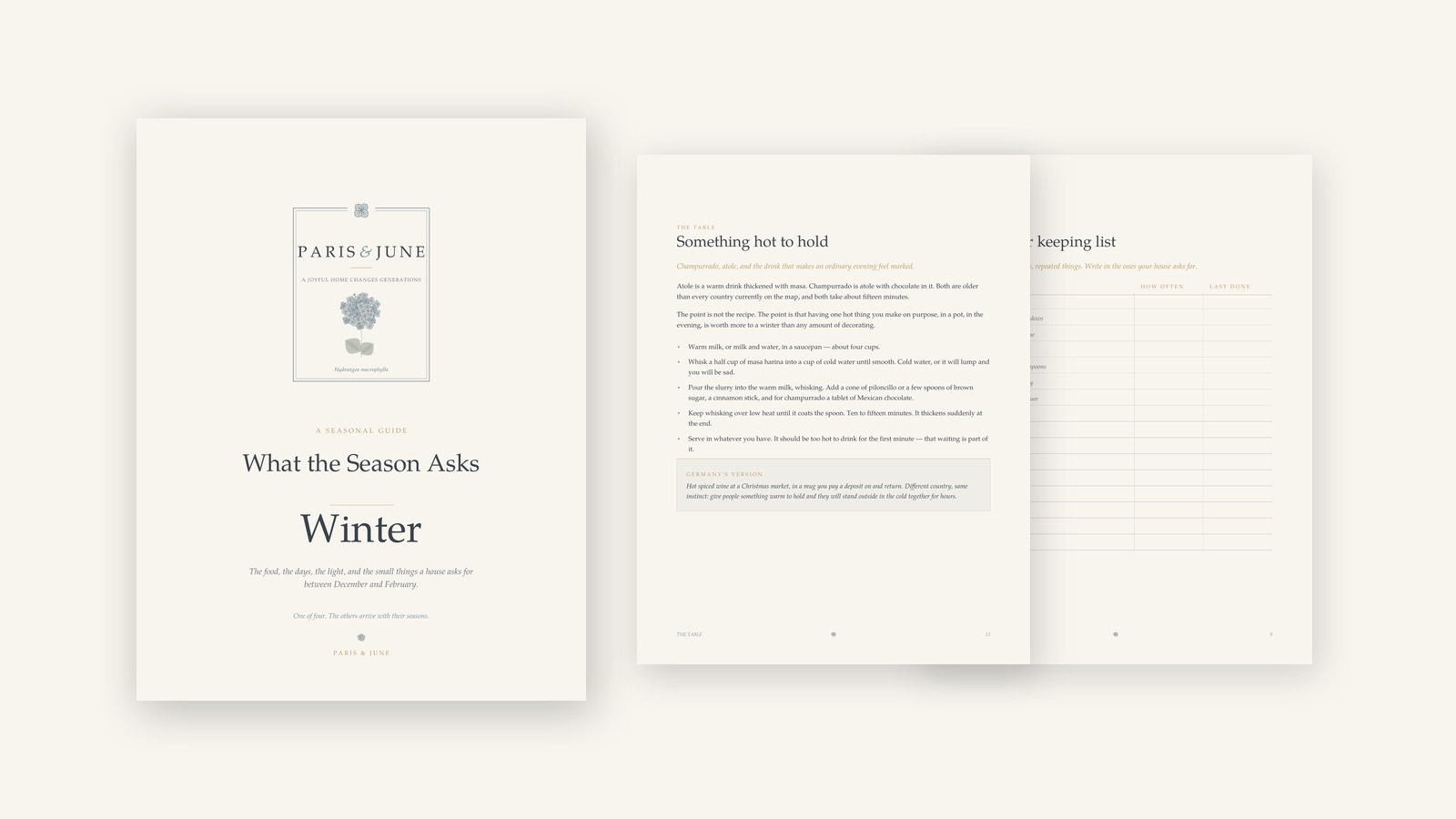
Twenty-seven pages, in five parts.
One · The House
What changes when a house stops being the place you leave from and becomes the place everyone comes back to. The real work of winter, which is light. What to do before the week it freezes, written for people who only freeze once or twice a year and are therefore in more danger than people who freeze all the time. And a keeping list for the small, unglamorous, repeated things.
Two · The Table
The pot that stays on — if you learn one thing this winter, learn beans. A tamalada: how to run one, and why it’s the most useful tradition I know. Atole and champurrado, for an ordinary evening you want to mark. Five dinners decided once in November so you stop deciding every day at four o’clock. And one page asking you to get a single recipe out of somebody’s hands and onto paper before this winter ends.
Three · The Days
The winter calendar you inherited is older than the one on your phone, and it is better built. December night by night — the small nightly thing children actually remember. January and the debt of tamales. And a page to choose this winter’s three traditions. Not ten. Three.
Four · The Body
What cold actually does to skin, which is not what summer dryness does. What works, and what’s sold to you. And the long evening — the hours between dinner and bed that are longer in winter than at any other time of the year, and what to put in them.
Five · The Record
Written in February while you still remember, because you will not remember in June. What’s worth repeating. What was a chore wearing a nice coat.
Who it’s for
If you have ever got to March and thought what did we even do, this is for you.
If you have children and you want them to remember something specific about winter rather than a general impression of indoor time, this is for you.
If you’d rather do three things properly than twenty-five things badly, this is very much for you.
Who it isn’t for
It isn’t a decorating guide. There are no shopping links and nothing to buy.
It isn’t a cleaning schedule or a productivity system.
And it isn’t neutral — it comes out of a Mexican kitchen, and the food and the days in it are the ones I was given. You are welcome in it. It just isn’t a generic winter.
What you get
A 27-page PDF. Instant download. Print it, or keep it on the iPad on the counter.
Fill-in pages for your own keeping list, your three traditions, and your February record.
Yours to print as many times as you like for your own house.
Instant download. If it isn’t for you, reply to the receipt and I’ll refund you — no form, no explaining.
Winter is not a season you survive. It is a season you keep.
Reviews
There are no reviews yet.